
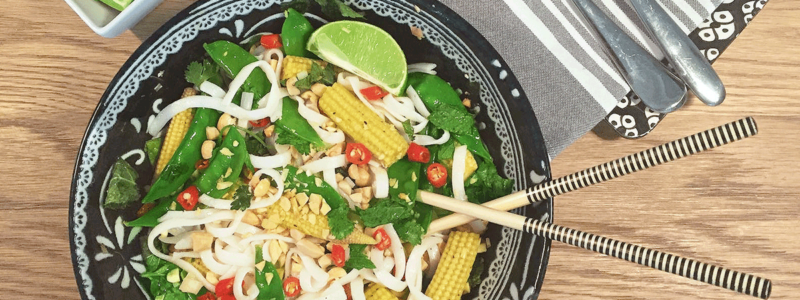
Why does homemade Thai noodle salad always taste flat compared to the version at a restaurant? Nine times out of ten, the answer is the dressing. Most recipes online cut corners — they swap fish sauce for soy sauce, use bottled lime juice, and skip palm sugar entirely. The result is technically a noodle salad, but it has none of the sharpness, depth, or sweetness that makes Thai food addictive.
This guide fixes that. You’ll learn which noodle type actually holds up in a cold salad, how to build a properly balanced dressing using real ingredients, and what most home cooks get wrong during assembly.
The Rice Noodle You Choose Changes Everything
Most recipes just say “rice noodles” and leave it there. That’s a problem, because rice noodles come in at least four common widths, and each behaves differently in a cold salad. Using the wrong one turns your dish gummy, clumped, or tasteless within minutes of dressing.
| Noodle Type | Width | Best For | Salad Performance | Common Brand |
|---|---|---|---|---|
| Rice Vermicelli (bún) | 1–2mm | Cold salads, fresh rolls | Excellent — stays separate, absorbs dressing evenly | Thai Kitchen, Three Ladies |
| Sen Lek (thin flat) | 3mm | Pad Thai, soups | Good — slightly chewier, holds up longer | Wai Wai, Erawan |
| Sen Yai (wide flat) | 10mm+ | Stir-fry, pad see ew | Poor — clumps badly when cold | Aroy-D, Caravelle |
| Glass Noodles (woon sen) | 2mm | Yum woon sen salads | Good — slippery, lighter texture | Longkou, generic mung bean |
For this salad, rice vermicelli is the right choice. Thai Kitchen sells 14oz bags for around $3.50 at most grocery stores and works consistently well. Three Ladies brand — usually cheaper and found at Asian grocery stores — is even better. The texture is slightly firmer and it doesn’t clump after 20 minutes of sitting dressed.
How to Cook Vermicelli So It Doesn’t Turn to Mush
Don’t boil vermicelli. Soak it instead.
- Bring a full kettle of water to a boil
- Pour it over the noodles in a large bowl
- Soak 4–5 minutes, tasting at the 4-minute mark
- Drain immediately, rinse under cold water for 30 seconds
- Toss with 1 teaspoon of neutral oil to prevent sticking
Boiling vermicelli in a pot overcooks the outer strands while the center stays firm. The soaking method gives you even, al dente texture throughout. Cold water stops the cooking instantly.
What If You Only Have Pad Thai Noodles?
Sen lek (3mm flat rice noodles, often labeled “Pad Thai noodles”) works in a pinch. Use the same soaking method but extend it to 7–8 minutes. The salad will be chewier. One critical difference: dress it while the noodles are still slightly warm — cold sen lek gets stiff and rubbery faster than vermicelli does.
How to Build the Dressing That Actually Tastes Thai
The dressing is the entire recipe. Every other element — the protein, the herbs, the crunch — exists to carry it into your mouth. If the dressing is off, the salad is off. Full stop.
A proper Thai salad dressing is a four-part balance: salty, sour, sweet, and heat. The mistake most Western recipes make is using soy sauce as the salty base. Soy sauce has a roasted, savory depth that pulls the flavor toward Chinese-American takeout territory. Fish sauce has a cleaner, more pungent salinity that’s essential for the right result.
Which Fish Sauce to Buy
There’s a real quality gap between bottles. The three most common options:
- Red Boat 40°N (~$12 for 17oz): Two-ingredient fermented anchovy sauce. Clean, round flavor with no off-notes. The best choice if you can find it.
- Megachef Premium Fish Sauce (~$8 for 25oz): Very close to Red Boat in quality at a lower price. Common in Asian grocery stores. This is the everyday pick.
- Tiparos or Squid Brand (~$3–4): Budget option. It works, but has a sharper, ammonia-forward smell. Use about 20% less than the recipe calls for and taste constantly.
Skip Three Crabs brand for this application — it’s designed for Vietnamese cooking and reads sweeter, which throws off the balance in a Thai dressing.
The Palm Sugar Question
Palm sugar dissolves easily and has a mild caramel note that white sugar doesn’t replicate. Aroy-D sells palm sugar discs for about $3–4 at Asian grocery stores. Kara brand comes in a tub and is easier to measure by the tablespoon. If you genuinely can’t find either, use light brown sugar as a 1:1 substitute — not white sugar, which makes the dressing taste thin and harsh.
The ratio that works consistently: 3 tablespoons fish sauce, 3 tablespoons fresh lime juice, 1.5 tablespoons palm sugar, 1–2 teaspoons sliced Thai chili. Taste after mixing. It should taste aggressively salty and sour at this stage — it mellows significantly once it coats 200g of noodles and all the vegetables.
The Tamarind Variable
Some Thai noodle salads include tamarind paste for a fruity tartness that lime alone can’t deliver. If you want that depth, dissolve 1 tablespoon of Tamicon tamarind concentrate in 2 tablespoons of warm water, then add it to the dressing. Reduce the lime juice by half when you do. The pure-lime version is brighter and cleaner. The tamarind version is richer and more complex. Both are correct — they’re just different flavor profiles.
Three Mistakes That Kill the Flavor
- Dressing cold noodles. Cold noodles are stiff and won’t absorb anything. Dress them while still slightly warm — right after rinsing and oiling. The residual heat opens the texture and lets the dressing penetrate instead of pooling at the bottom of the bowl.
- Adding fresh herbs too early. Thai basil, cilantro, and mint wilt and turn slimy within 10 minutes of contact with an acidic dressing. Add all fresh herbs right before serving. If prepping ahead, store dressed noodles and herbs in separate containers and combine at the last minute.
- Using pre-roasted peanuts from a jar. The peanuts sold pre-roasted in sealed bags have a soft, stale texture that disappears into the salad. Toast raw peanuts in a dry skillet for 5–6 minutes until fragrant. The result is a crunch that holds up even after 30 minutes of sitting in the dressed salad. Raw peanuts sold in bulk at Asian grocery stores are usually cheaper and fresher than anything in a branded jar anyway.
One more detail worth mentioning: don’t skip the shallots. Thinly sliced raw shallot adds a sharper allium bite than red onion (too aggressive) or green onion (too mild). It’s the small thing that makes the salad taste specifically Thai rather than vaguely Asian.
Full Thai Rice Noodle Salad: Complete Recipe
Serves 4 as a side, 2 as a main. Prep time: 20 minutes once noodles are soaked.
Ingredients
- 200g (7oz) rice vermicelli, soaked and drained
- 1 cup shredded purple cabbage
- 1 cup shredded carrots (about 2 medium)
- 1 English cucumber, halved and thinly sliced
- 2 shallots, very thinly sliced
- 1 cup fresh bean sprouts
- ½ cup fresh mint leaves
- ½ cup fresh cilantro leaves
- ¼ cup fresh Thai basil (regular basil works)
- ⅓ cup raw peanuts, toasted and roughly chopped
- Optional protein: 200g grilled chicken, shrimp, or firm tofu
Dressing: 3 tbsp fish sauce (Red Boat or Megachef), 3 tbsp fresh lime juice, 1.5 tbsp palm sugar (Aroy-D) dissolved in 1 tbsp warm water, 1 clove garlic finely grated, 1–2 Thai chilies thinly sliced.
Assembly Order
Order matters. This is why restaurant versions taste more cohesive than home versions:
- Whisk all dressing ingredients. Taste — it should be bold and sharp right now.
- In a large bowl, combine warm drained noodles with the dressing. Toss well, let sit 3 minutes.
- Add cabbage, carrots, cucumber, shallots, and bean sprouts. Toss again.
- Fold in protein if using.
- Right before serving: add mint, cilantro, and Thai basil. One gentle toss.
- Plate and top with toasted peanuts. Serve immediately.
The noodles absorb a significant amount of dressing within 5 minutes. If making this more than an hour ahead, hold back half the dressing and add it fresh at serving time.
When This Salad Works — and When It Doesn’t
This is one of the best dishes to bring to a summer gathering — it travels well, tastes good at room temperature, and handles dietary restrictions easily. It doesn’t work as a pre-made lunch with herbs and peanuts already mixed in. They’ll be soggy by noon.
The move that actually holds up: dress the noodles the night before, keep herbs and peanuts separate, combine the morning you eat it. That’s the version that closes the gap between flat homemade and the bright, layered salad that made you want to recreate it in the first place.
Medical Disclaimer: This content is for informational purposes only and does not constitute medical advice. Always consult a qualified healthcare professional before making health-related decisions.